Table of Contents
Intelligent Oracles & the World Wild Web
To understand where we are going, we need to first acknowledge the limitations of where we are. Traditional smart contracts are powerful, but they are fundamentally isolated. They rely on deterministic code and internal on-chain state, effectively operating in a black box. To "see" the outside world they require third-party intermediaries– standard oracles – to push data to them.
Intelligent Oracles break this isolation.
Built on GenLayer, they act as a gate to the outside world and operate within a native Python environment capable of executing non-deterministic tasks. Functionally, it is an Intelligent Contract designed to fetch arbitrary public web data (text, HTML, or images), processing it via Large Language Models (LLMs), and reaching trustless consensus on the result. They do not merely store data; they possess the logic to interpret it.
The engineering challenge lies in consensus: How does a decentralized network agree on the content of a dynamic website? Since web data and AI inference can be non-deterministic, different nodes might return different results for the same task.
GenLayer resolves this via Optimistic Democracy. Instead of relying on a single data source, a randomly selected set of validators is tasked to reach a consensus. A randomly selected leader proposes a result, and a committee of validators verify this result based on the pre-defined “rules of agreement”.
These rules are known as Equivalence Principles:
- Strict Equivalence (gl.eq_principle.strict_eq): Validators execute the task independently and demand an exact character-for-character match with the Leader's result. Ideal for deterministic data like token prices.
- Comparative Equivalence (gl.eq_principle.prompt_comparative): Validators execute the task independently. To verify, they run an LLM prompt that evaluates both the Leader's result and their own result against a developer-defined criteria. Agreement is established if the LLM determines that the relationship between the two outputs satisfies this criteria.
- Non-Comparative Equivalence (gl.eq_principle.prompt_non_comparative): Validators do not re-run the task; instead, they use an LLM to act as a judge, verifying if the Leader's proposed result logically satisfies a developer-defined criteria.
- Custom Equivalence: For advanced use cases, developers are not limited to these defaults. You can define fully arbitrary Python functions that dictates exactly how the Leader's and Validators must reach consensus.
Note: A deeper analysis of the mechanics of Optimistic Democracy and the Equivalence Principles are beyond the scope of this article. If you want a full breakdown of the consensus architecture, you can read more here.
The Oracle Landscape
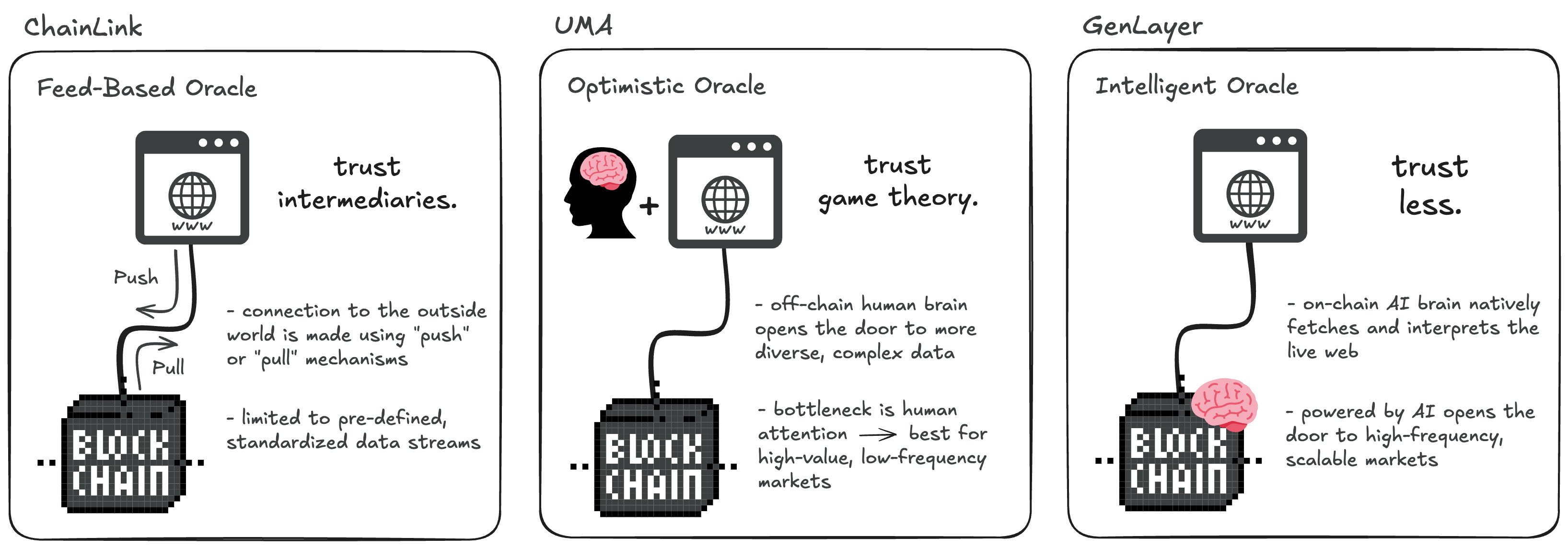
The distinction between Intelligent Oracles and existing solutions is best understood by categorizing how data enters the blockchain. To function, they rely on oracles: off-chain intermediaries pushing data on-chain. These can be reduced to two dominant architectures: real-time data feeds or disputable data proposals by human participants.
Feed-Based Oracles (Chainlink, Pyth) are high-speed subscription services. It is incredibly efficient for standard data like asset prices, but it is rigid: the existence of your application depends on a specific data stream being supported.
To bypass this limitation, Optimistic Oracles (UMA) allow for more open-ended, but slower data proposals. Anyone can submit a result by staking a financial bond, and the system assumes it is true unless explicitly challenged during a "liveness period." While flexible, this model hits a hidden ceiling: human attention. Disputes require manual voting. You cannot ask a DAO to verify 10,000 micro-transactions a day. Consequently, these models naturally gravitate toward high-value, low-frequency markets, effectively ignoring the "long tail" of daily, lower-stakes disputes.
GenLayer introduces a third path: Intelligent Oracles fix blindness by giving your application a brain and access to the outside world. Open and trustless.
How do Intelligent Oracles work?
The most common application of an Intelligent Oracle is converting the chaotic, unstructured web into structured on-chain facts.
To understand the power of Intelligent Oracles, we don't need hypothetical scenarios. All builders rely on the same simple loop that breaks the boundaries of the standard EVM:
- gl.nondet.web.render(): The ability to leave the blockchain and access the web.
- gl.nondet.exec_prompt(): The ability to process that data with an LLM.
- gl.eq_principle: The rules that force the network of AI models to reach a consensus on a single truth.
The choice of Equivalence Principle depends entirely on the nature of the data you need:
- Use syntax equivalence (strict_eq) if you need the output to be identical across all nodes (e.g., extracting a specific address, or historical data of a given token, etc.).
- Use semantic equivalence (prompt_non_comparative, prompt_comparative) if you are extracting text where phrasing might vary but the meaning must remain the same (e.g., summarizing a news article or sentiment analysis).
- Use custom validation: If you are fetching highly volatile data (like live token prices). Since these values change moment-to-moment, strict equivalence often fails. You also probably don't want to do a full comparative LLM call, or at least it's not efficient. Here, a custom equivalence allows you to define a "tolerance range" (e.g., prices must not differ by more than 1%) rather than demanding an exact match.
The "Reader" Pattern (“text” or “html”)
In this pattern, the contract fetches the content in text or HTML format (triggering the validator node to render a specific URL), and then feeds that content to an LLM to extract specific information.
Example: A Bitcoin Price Oracle
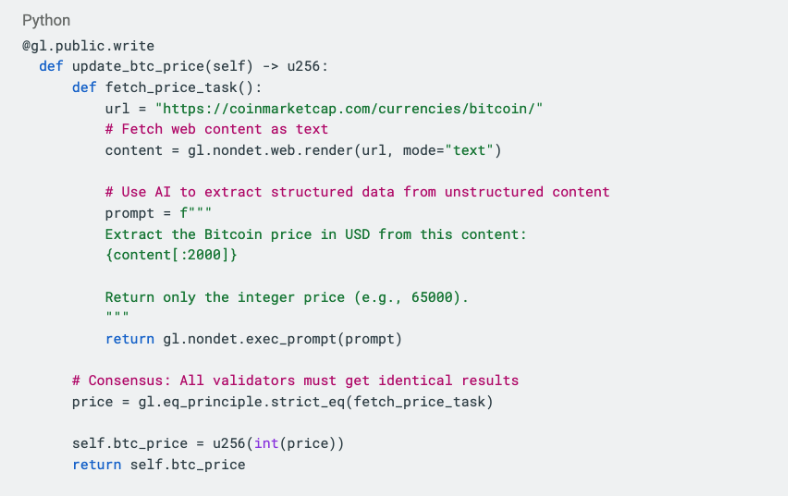
You can access the full example here.
The "Vision" Pattern (“screenshot”)
While text is powerful, some truths are visual. This pattern leverages Multimodal LLMs to process and interpret images.
Unlike text extraction, visual analysis is inherently subjective. Two people might describe the same image differently. Therefore, this pattern best works when looking for semantic alignment.
Example: The "Proof of Steak" Verifier
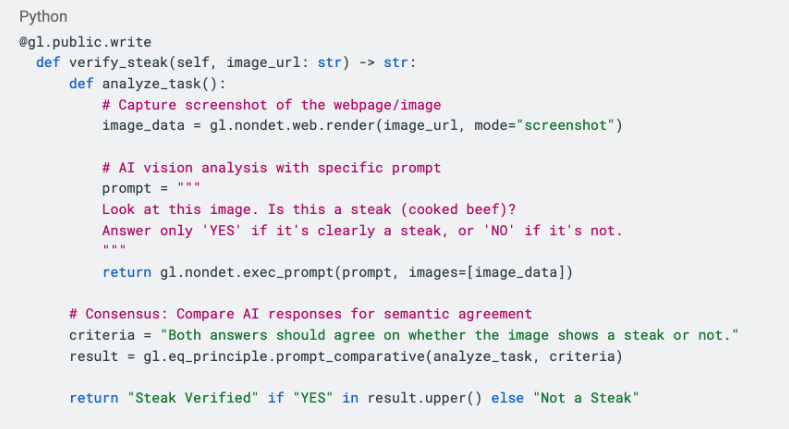
You can access the full example here.
From Theory to Practice
These patterns are not hypothetical; they are currently being deployed by builders to solve problems that were previously impossible on-chain.
- Luk’s "Proof of Steak": Winner of the GenLayer Nov 2025 Hackathon, this project utilized the Vision Pattern to create a fun, verifiable social game. Users upload photos of their dinner or other content, and the decentralized jury validates and scores the content.
- Ying’s Price Prediction Oracle: Using the Reader Pattern, Ying built a system that fetches raw HTML from major news sites and exchanges, effectively turning any public URL into a potential oracle source without needing API keys or permission.
- Jay’s "Watchdog": A security application that monitors the health of external servers (like GitHub or CoinGecko). It uses the Reader Pattern to detect downtime and automatically triggers on-chain circuit breakers to pause contracts during outages.
- Pavel’s "Guess the Picture": A gamified implementation of the Vision Pattern where users draw concepts and an AI jury scores them based on semantic accuracy.
We now have contracts that see, read, and react. However, leaving the deterministic safety of the EVM for the volatility of the internet isn't without its risks. To build systems that last, understanding the limitations of Intelligent Oracles becomes as important as understanding its capabilities.
Current limitations: The Fragility of “Truth”
The biggest challenge isn't the AI; it's the “World Wild Web” itself, an environment where stability is rare. A reliable source today might be paywalled, blocked by Cloudflare, or offline tomorrow. This creates a dangerous friction: if you hardcode a specific URL into your contract to ensure "trustlessness," you bet on that website never changing its anti-bot policy. Relying on static URLs acts as a single point of failure that can force a costly redeployment.
Builder Tip: Before you deploy any contract, verify your sources. You can use Intelligent Crawler to confirm if your target URL content is actually accessible.
On the other hand, allowing users to submit any URL is equally dangerous. A malicious actor could easily spin up a fake news site or a clone of a reputable domain to feed false data to your oracle. The solution lies in the middle: Domain Whitelisting. Builders must treat URLs as mutable state, not static code. By maintaining an on-chain list of approved, credible domains (e.g., coindesk.com, bbc.com), you prevent misinformation and give your protocol the flexibility to switch sources if a specific URL breaks, all in a trustless manner.
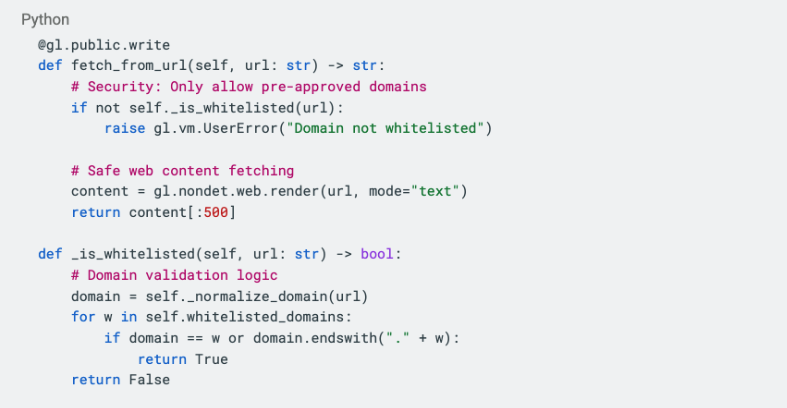
See the full code here.
Moreover, while Intelligent Oracles can technically fetch data from any API using standard HTTP requests (GET/POST), there is a catch: privacy. Most APIs require a private API Key for authentication. In a traditional server, you hide this key in a secure .env file. But on a blockchain, everything is transparent. If you hardcode your OPENAI_API_KEY or BLOOMBERG_KEY into your contract, it becomes visible to every validator and block explorer on the network. This makes integrating private, subscription-based APIs unrealistic in the current model, as malicious actors could instantly scrape your key and drain your quota.
Finally, the cost of intelligence. GenLayer runs multiple LLM inferences for every consensus round. Don't use a supercomputer for a calculator’s job. If you just need the price of ETH, use a dedicated, deterministic feed like Chainlink or Pyth; they are faster and cheaper for that specific task. Save GenLayer for the "Long Tail": the millions of subjective, messy, and complex questions that require understanding, not just arithmetic.
Potential: Intelligent Oracles as Economic Agents
While privacy remains a constraint, the industry is converging on a solution that transforms Intelligent Oracles from passive readers into active Economic Agents.
The most promising standard driving this is the x402 Protocol (built on HTTP 402 "Payment Required").
x402 flips the authentication model: instead of hiding a secret API key, the Oracle simply pays for what it consumes. When a contract requests premium data, the server returns a payment address instead of content. The Oracle then autonomously signs a micro-transaction to "unlock" the response.
This effectively removes the need for secrets. "Authentication" becomes "Payment."
While friction remains—specifically around cross-chain micro-payments for an Oracle running on GenLayer—this architecture opens a massive door. It paves the way for a future where Intelligent Contracts don't just scrape the open web; they natively navigate, negotiate, and pay for high-quality, gatekept information without ever holding a private key.
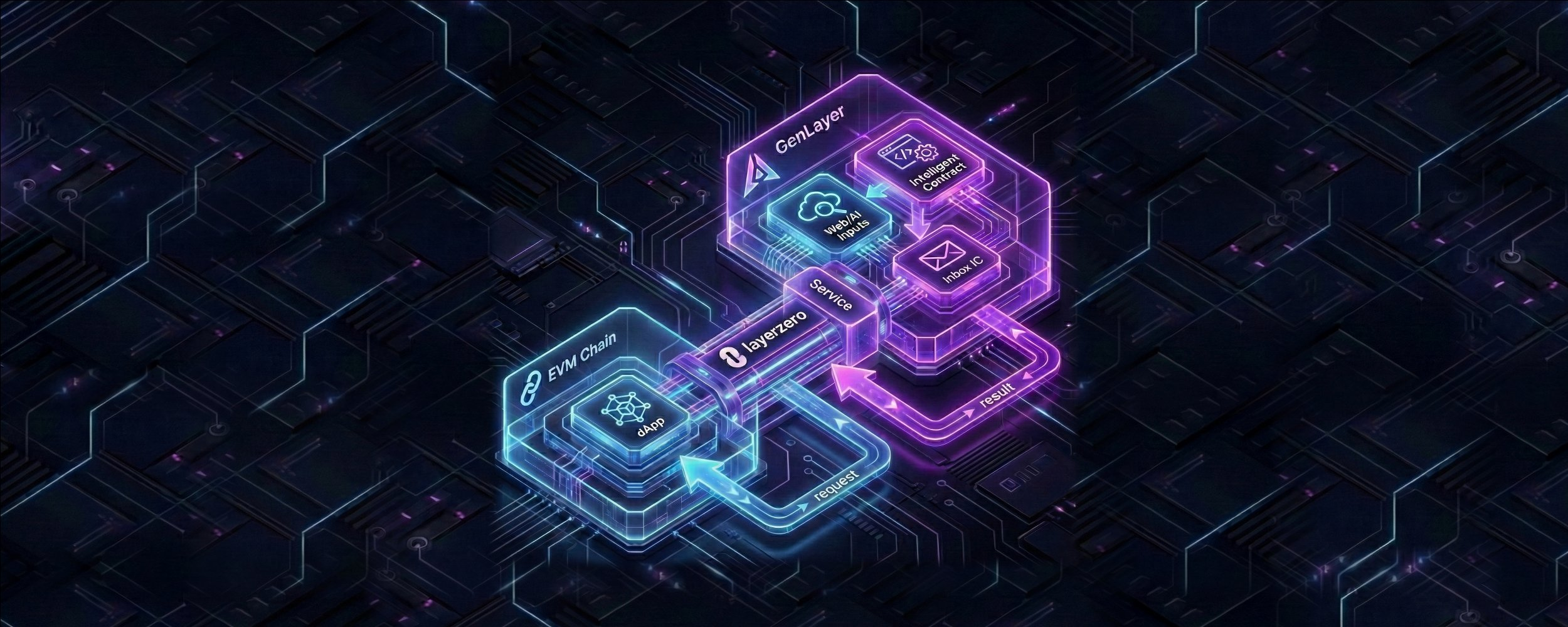
It is important to clarify: GenLayer is not trying to be another generic L1 or L2 to replace your current chain. It acts as a Resolution Layer that plugs into other dApps to handle non-deterministic decisions, a "court of the internet".
We have moved from "Smart" contracts that calculate to "Intelligent" contracts that understand. If you want to start building right now, visit IntelligentOracle.com.
You won't just find documentation there. You will find a specialized AI Agent ready to assist you in implementing your first Intelligent Oracle pattern in real-time. The infrastructure is live. The browser is open. The only thing missing is what you decide to build next.
Start building your first cross-chain Intelligent dApp. Don't miss our Builders Program at points.genlayer.foundation.
Related articles
.png)
Announcing Testnet Bradbury
Explore Testnet Bradbury: GenLayer’s "scholar’s gym" where AI meets blockchain consensus. Learn about greyboxing, model routing, and the road to Mainnet.
Intelligent Oracles & the World Wild Web
Stop building "blind" contracts. GenLayer Intelligent Oracles give dApps a brain to read, see, and reason with web data in a trustless environment.